
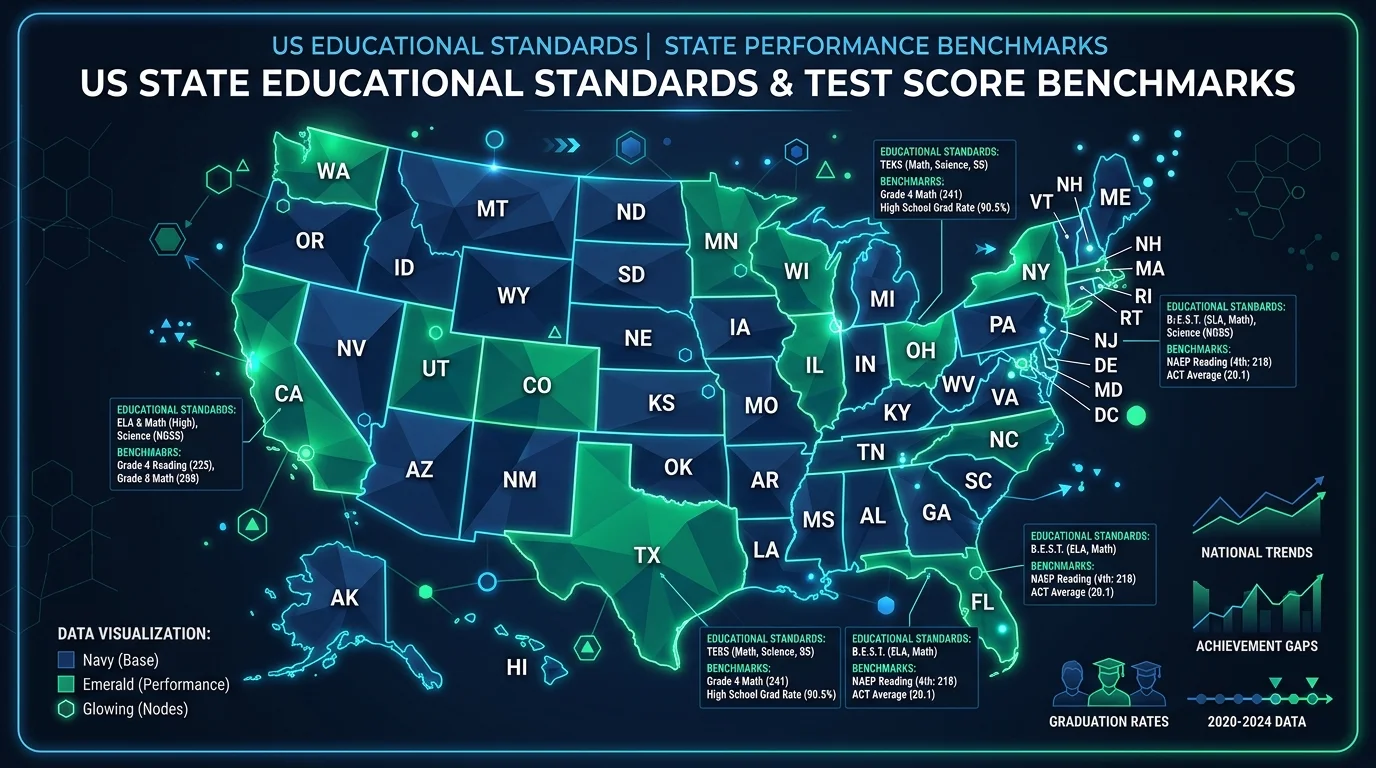
How State Qualifying Standards Are Established
Under the federal Every Student Succeeds Act (ESSA), all paraprofessionals working in instructional capacities in Title I funded schools must demonstrate core academic competency. States meet this mandate through three primary pathways:
- Completed Higher Education: Holding an associate degree (AA/AS) or higher from an accredited college.
- College Semester Credits: Having completed two years of full-time postsecondary study (typically 48 to 60 semester credit hours).
- State-Approved Standardized Assessment: Achieving a passing scaled score on a formal evaluation such as the ETS ParaPro Assessment (1755).
Summary Table of State Qualifying Scores
| State / Jurisdiction | Passing Cutoff | Assessment Code | Policy Type |
|---|---|---|---|
| Alaska (AK) | 459 | ETS ParaPro (1755) | Statewide Standard |
| Arizona (AZ) | 459 | ETS ParaPro (1755) | Statewide Standard |
| Arkansas (AR) | 457 | ETS ParaPro (1755) | Statewide Standard |
| California (CA) | Varies (455-460) | ParaPro / CBEST / Local LEA Exam | District Determined |
| Colorado (CO) | 460 | ETS ParaPro (1755) | Statewide Standard |
| Connecticut (CT) | 457 | ETS ParaPro (1755) | Statewide Standard |
| Delaware (DE) | 459 | ETS ParaPro (1755) | Statewide Standard |
| District of Columbia (DC) | 461 | ETS ParaPro (1755) | Statewide Standard |
| Florida (FL) | 440–464 (District) | ETS ParaPro (1755) | District Determined |
| Georgia (GA) | 450 | ETS ParaPro (1755) / GACE Paraprofessional | Statewide Standard |
| Hawaii (HI) | 459 | ETS ParaPro (1755) | Statewide Standard |
| Idaho (ID) | 460 | ETS ParaPro (1755) | Statewide Standard |
| Illinois (IL) | 460 | ETS ParaPro (1755) / ACT WorkKeys | Statewide Standard |
| Indiana (IN) | 460 | ETS ParaPro (1755) | Statewide Standard |
| Iowa (IA) | 460 | ETS ParaPro (1755) | Statewide Standard |
State-Specific Paraprofessional Certification Hubs
Need detailed certification pathways, state department of education codes, and local school district hiring benchmarks? Explore our in-depth guides:
Ohio ParaPro Guide (456)
ODEW requirements, Educational Aide Permit with ESEA endorsement, and district benchmarks.
Florida ParaPro Guide (464)
FLDOE standards, district hiring policies (Miami-Dade, Hillsborough), and test centers.
Texas ParaPro Guide (467/450)
TEA Educational Aide I/II/III certification, ESC testing centers, and ISD cutoffs.
Illinois ParaPro Guide (460)
ISBE Educator License with Stipulations (ELS-PARA), ROE approvals, and CPS policies.
Colorado ParaPro Guide (460)
CDE Title I requirements, Denver Public Schools, Jeffco, and Cherry Creek hiring standards.
Virginia ParaPro Guide (455)
VDOE standards, Fairfax County, Prince William County, and Virginia Beach policies.
Washington Paraeducator Guide (461)
OSPI Paraeducator Certificate Program, PESB Fundamental Course of Study (FCS 28 hrs).
Maryland ParaPro Guide (455)
MSDE Title I requirements, Montgomery County (MCPS), Prince George's, and Baltimore.
New Jersey ParaPro Guide (456)
NJDOE standards, Executive County Superintendent approvals, and Newark/Jersey City policies.
Preparing for Your State's Cutoff
Full 90-Q Diagnostic Exam
Test your readiness against your state's cutoff with our full 150-minute exam simulation.
Raw to Scaled Score Calculator
Compute how many correct answers you need to meet your specific state passing score.
Frequently Asked Questions About State Passing Scores
Does ETS establish the passing score for the ParaPro test?
No. Educational Testing Service (ETS) only administers the exam and reports scaled scores (420–480). Passing cutoffs are legally established by each individual state department of education or local school district.
What is the most common state passing score?
The national median passing score is between 455 and 460. For example, Ohio and New Jersey require 456; Virginia and Maryland require 455; Colorado, Idaho, Illinois, and Indiana require 460; while Massachusetts, DC, and Washington require 461–464.
Can I transfer my ParaPro score to another state?
Yes. Because the ParaPro Assessment (Test 1755) is a standardized national test, your official ETS score report can be sent to other state licensing agencies. If your score meets that state's cutoff, it will be accepted.
What if my state does not have a statewide passing score?
In states like Florida, Texas, and California, qualifying scores or assessment requirements are determined at the local school district or county level. Always verify with your target district HR department.