
Skip to Main Content →
Independent Resource ParaPro® and Praxis® are registered trademarks of Educational Testing Service (ETS). This website is an independent educational prep resource and is not affiliated with or endorsed by ETS or any state department of education. Full Disclaimer →
Student reading comprehension study materials and highlighted main idea notes
✨ AI Visual
The ParaPro Reading section evaluates critical passage analysis and classroom literacy intervention skills.

Structure of the ParaPro Reading Comprehension Subtest

The Reading section evaluates your ability to read, comprehend, and analyze written informational texts, as well as your readiness to support classroom teachers during small-group reading instruction. The section contains 30 questions:

  • Reading Skills and Knowledge (approx. 18 questions): Identifying main ideas, locating explicit supporting facts, drawing valid inferences, determining author purpose and tone, recognizing fact vs. opinion, and determining word meanings from context.
  • Application of Reading Skills in the Classroom (approx. 12 questions): Helping students use alphabetizing tools, decoding multi-syllable words using prefixes/roots/suffixes, interpreting graphic organizers, and following multi-step instructional directions.

Main Idea Strategy & Decision Tree Flowchart

Follow this systematic elimination flowchart to isolate the author's overarching thesis from minor supporting details:
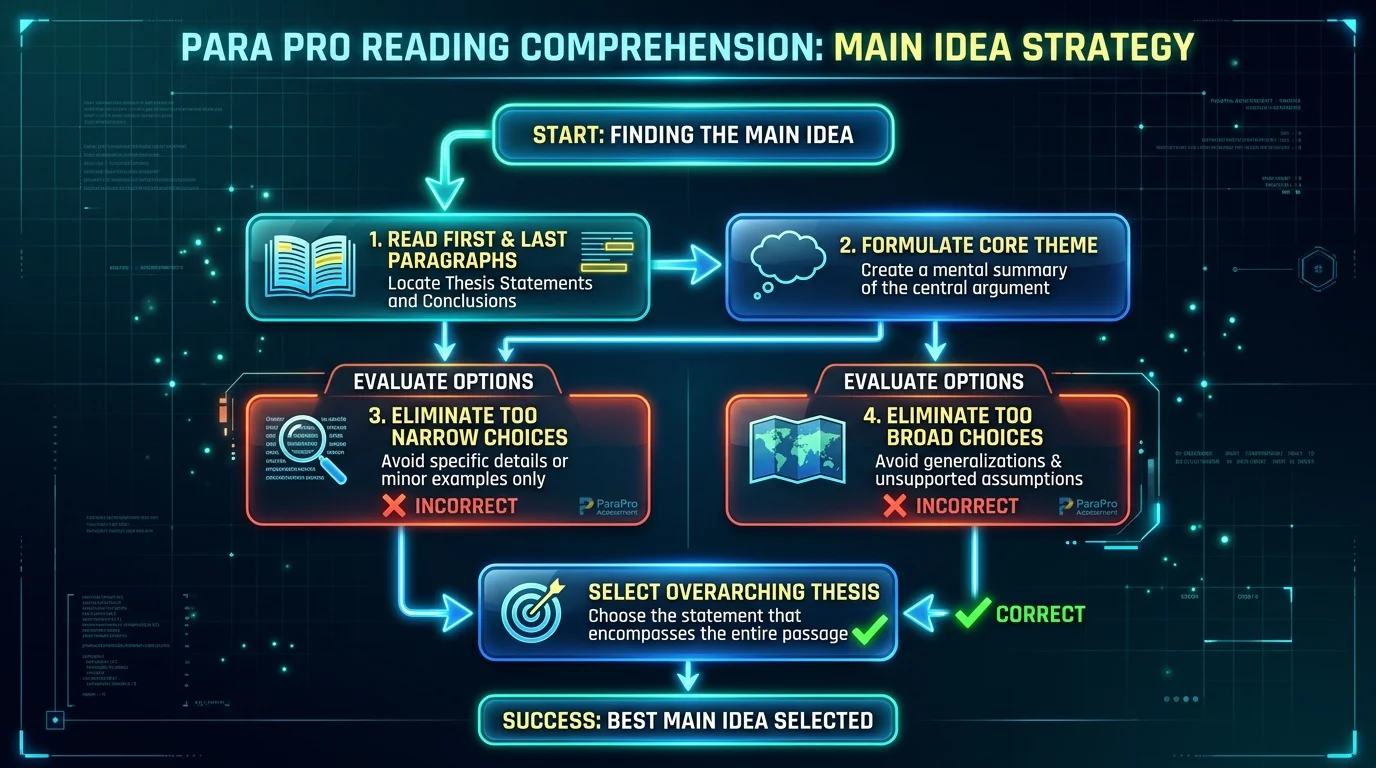
Reading Comprehension Main Idea vs Supporting Detail Elimination Strategy Flowchart for ParaPro Test Takers
✨ AI Visual
Reading Comprehension Strategy Flowchart: Locating central themes and eliminating too-narrow or too-broad distractors.

Top 3 Reading Traps to Avoid

  1. The 'True But Unmentioned' Trap: An answer choice may state an accurate real-world scientific or historical fact, but if it is not supported directly by the text, it is incorrect.
  2. Extreme Absolute Phrasing: Choices containing words like "always", "never", "only", or "impossible" are rarely the correct answer on standardized reading exams.
  3. Confusing Main Idea with Supporting Details: A supporting detail provides evidence for the thesis, but does not capture the complete scope of the author's primary argument.

Static Question Curriculum Preview (Indexed Questions)

Below are representative reading comprehension questions, authentic passages, and step-by-step solutions from this module:

Question 1: Which of the following best expresses the primary main idea of the passage?
Passage Excerpt: Coral reefs are among the most biodiverse and economically valuable ecosystems on Earth, often referred to as the 'rainforests of the sea.' Although they occupy less than 0.1% of the global ocean floor, reefs provide shelter, nursery grounds, and foraging habitats for more than 25% of all known mari...
Choices: (A) Coral reefs cover only a small percentage of the ocean floor but are home to many fish. • (B) Zooxanthellae are single-celled algae that require carbon dioxide to perform photosynthesis. • (C) Coral reefs are vital marine ecosystems sustained by a delicate symbiosis that is severely threatened by ocean warming and acidification. • (D) Ocean acidification is caused exclusively by global warming in tropical waters.
Correct Answer: (C) Coral reefs are vital marine ecosystems sustained by a delicate symbiosis that is severely threatened by ocean warming and acidification.
Explanation: The passage discusses both the ecological importance and symbiotic biology of coral reefs in paragraph 1, and explains how rising temperatures and ocean acidification threaten their survival in paragraph 2. Option C accurately encompasses the full scope.
Question 2: According to the passage, what specific benefit do corals provide to zooxanthellae in their symbiotic relationship?
Passage Excerpt: Coral reefs are among the most biodiverse and economically valuable ecosystems on Earth, often referred to as the 'rainforests of the sea.' Although they occupy less than 0.1% of the global ocean floor, reefs provide shelter, nursery grounds, and foraging habitats for more than 25% of all known mari...
Choices: (A) Direct sunlight and oxygen for cellular respiration. • (B) A protected living environment and essential metabolic compounds. • (C) Calcium carbonate ions for algal cell wall precipitation. • (D) Reactive oxygen species that protect against bacterial pathogens.
Correct Answer: (B) A protected living environment and essential metabolic compounds.
Explanation: Paragraph 1 explicitly states: 'corals provide the algae with a protected environment and essential metabolic compounds (carbon dioxide, ammonium, and phosphate).'
Question 3: As used in paragraph 2, the word 'bleaching' most nearly refers to:
Passage Excerpt: Coral reefs are among the most biodiverse and economically valuable ecosystems on Earth, often referred to as the 'rainforests of the sea.' Although they occupy less than 0.1% of the global ocean floor, reefs provide shelter, nursery grounds, and foraging habitats for more than 25% of all known mari...
Choices: (A) The physical sanding of corals by violent ocean storm surges. • (B) The process where corals turn white after expelling their symbiotic algae. • (C) The artificial chemical treatment of coral specimens in scientific laboratories. • (D) The rapid growth of predatory marine starfish across the reef crest.
Correct Answer: (B) The process where corals turn white after expelling their symbiotic algae.
Explanation: Paragraph 2 defines coral bleaching as occurring when 'the coral host expels the algae, causing the coral tissues to turn translucent white in a phenomenon known as coral bleaching.'
Question 4: Based on paragraph 2, what can be reasonably inferred about the effect of ocean acidification on coral reefs?
Passage Excerpt: Coral reefs are among the most biodiverse and economically valuable ecosystems on Earth, often referred to as the 'rainforests of the sea.' Although they occupy less than 0.1% of the global ocean floor, reefs provide shelter, nursery grounds, and foraging habitats for more than 25% of all known mari...
Choices: (A) Acidification completely neutralizes thermal stress in shallow tropical lagoons. • (B) Acidification increases the speed at which zooxanthellae produce glucose. • (C) Acidification reduces the availability of chemical building blocks needed for corals to rebuild skeletons. • (D) Acidification only affects non-calcifying soft corals.
Correct Answer: (C) Acidification reduces the availability of chemical building blocks needed for corals to rebuild skeletons.
Explanation: Paragraph 2 states that ocean acidification 'reduces the saturation state of carbonate ions, drastically impeding the calcification rates necessary for reef structural repair,' meaning the chemical building blocks are depleted.
Question 5: An instructional aide is assisting a 5th-grade student who is confused by the term 'endosymbiotic relationship' in paragraph 1. Which instructional approach is most effective?
Passage Excerpt: Coral reefs are among the most biodiverse and economically valuable ecosystems on Earth, often referred to as the 'rainforests of the sea.' Although they occupy less than 0.1% of the global ocean floor, reefs provide shelter, nursery grounds, and foraging habitats for more than 25% of all known mari...
Choices: (A) Instruct the student to skip the paragraph because scientific vocabulary is not tested. • (B) Break down the word into 'endo' (inside) and 'symbiosis' (living together to help each other) using an everyday analogy like roommates sharing chores. • (C) Tell the student to copy the entire paragraph into their notebook three times. • (D) Define the term as meaning that one organism attacks and destroys another.
Correct Answer: (B) Break down the word into 'endo' (inside) and 'symbiosis' (living together to help each other) using an everyday analogy like roommates sharing chores.
Explanation: Morphological word analysis ('endo' = inside, 'symbiosis' = mutually beneficial living together) paired with concrete relatable analogies helps students construct durable conceptual understanding.

Continue Your Practice Preparation

📖 Set 2

Reading Practice Test (Set 2)

Take 30 additional reading comprehension questions with diverse passage genres.

💡 Study Guide

Identifying Main Idea Guide

Master strategies for finding the central thesis and distinguishing facts from author opinions.

Frequently Asked Questions About ParaPro Reading

What types of reading passages appear on the ParaPro exam?

Passages range from 100 to 300 words and cover non-fiction topics such as science, American history, education, social studies, and practical classroom memos.

How are classroom reading application questions formatted?

These questions ask you how to support a student who struggles with reading comprehension, phonetic decoding, following multi-step directions, or identifying main ideas.

What is the best strategy for answering ParaPro reading questions?

Read the questions and answer choices first to establish an active purpose, then read the passage carefully, eliminating answer choices that introduce unsupported outside claims.